Fuel, Not Punishment
Eating and drinking for the long run — how your body actually burns fuel over 26.2 miles, why the wall is a predictable physics problem, and how to train your gut so race day feels boring.
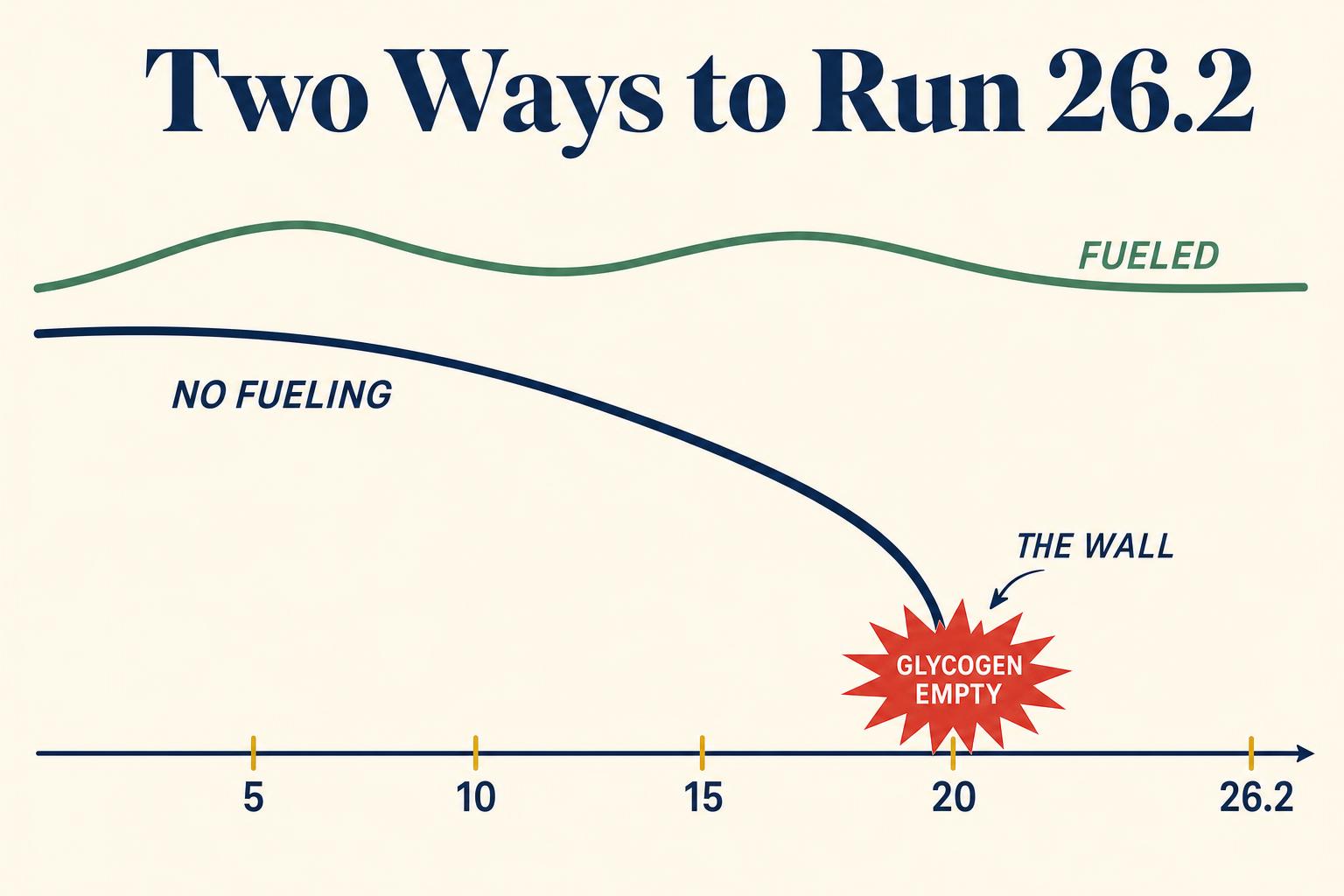
It's mile 21 of the Chicago Marathon. You've trained for months, your legs feel strong, your pacing has been disciplined. Then, over the span of a single mile, everything changes. Your legs turn to concrete. Your brain fills with fog. Runners who were behind you begin streaming past. You haven't injured anything. You haven't done anything wrong with your running form. You've simply run out of fuel — your glycogen stores are depleted, and your body is trying to run a high-performance engine on fumes.
This is THE WALL, and it is not a test of willpower. It is a predictable, physiological event with a straightforward cause and, crucially, a preventable one. Understanding why it happens, and what to do about it, starts with understanding your body as a fuel-burning machine.
Your Body's Two Fuel Tanks
When you run, your muscles draw on two primary fuel sources simultaneously: carbohydrates, stored as glycogen in your muscles and liver, and fat, stored abundantly throughout your body. Think of these as two fuel tanks of very different sizes. Your glycogen tank is small but powerful — the average trained runner stores roughly fifteen hundred to two thousand calories of glycogen. Your fat stores, even in a lean runner, contain fifty thousand or more calories. The math seems simple: just burn fat. But biology is more complicated than arithmetic.
Here's the critical concept: the crossover point. At low intensities — a gentle walk, an easy shuffle — your body burns mostly fat. As your effort increases, the fuel mix shifts toward a higher percentage of carbohydrates. At easy conversational pace, remember from the earlier discussion of pacing, you might be burning roughly fifty to sixty percent fat and forty to fifty percent carbohydrate. At marathon race pace for a newer runner, that ratio might shift to seventy to eighty percent carbohydrate. At a hard sprint, it's nearly all carbohydrate.
This is why pace matters so profoundly for marathon fueling. Running too fast doesn't just tire your legs — it drains your glycogen tank faster. And when that tank empties, your body is forced to rely almost entirely on fat oxidation, which simply cannot produce energy fast enough to maintain your pace. The result? You slow dramatically. That's the wall, as Rapoport described in 2010.
The Mathematics of the Wall
A large-scale analysis of over four million marathon race records found a consistent pattern: sustained pace collapse after mile 20, concentrated most heavily between miles 20 and 22. This research by Smyth and colleagues in 2021 shows this isn't coincidence. The mathematics of glycogen depletion predict it almost exactly. A runner burning approximately one hundred calories per mile — a reasonable estimate for a 150-pound runner — and deriving seventy percent of that energy from carbohydrate will burn through roughly eighteen hundred to two thousand calories of carbohydrate by mile 20. That's the entire glycogen tank.
Rapoport's computational model from 2010 demonstrated that more than two-fifths of marathon runners experience severe glycogen depletion. The model shows that exactly when you hit the wall depends on individual variables: your muscle mass, your glycogen storage density, your running speed relative to your aerobic capacity, and, critically, whether you take in carbohydrates during the race.
Consider this connection to the emphasis on easy pace from earlier: if running at easy pace burns fifty percent carbohydrate and running at race pace burns seventy-five percent carbohydrate, how much longer would your glycogen last at the slower pace? This is one more reason why going out too fast in a marathon is so devastating — it's not just about tired legs, it's about burning through your fuel too quickly.
Day-to-Day Nutrition: Fueling the Training
Race-day nutrition gets all the attention, but what you eat in the weeks and months of training matters far more. Your body rebuilds itself — repairing muscle damage, strengthening bones, adapting cardiovascular capacity — between runs, and it cannot do that work without adequate raw materials. The single most common nutritional mistake among marathon trainees, particularly first-timers, is UNDER-FUELING.
This isn't about eating "clean" or "perfect." It's about eating enough. Marathon training at a recreational level adds roughly four hundred to eight hundred additional calories of expenditure per day, depending on your training volume that week. When runners don't compensate for this increased demand — whether deliberately, trying to lose weight while training, or inadvertently, not realizing how much more they need — the consequences cascade. A syndrome called Relative Energy Deficiency in Sport, or R-E-D-S, describes what happens when chronic low energy availability compromises the body's ability to function and adapt. This was documented by Mountjoy and colleagues in 2022.
R-E-D-S isn't just about elite athletes or eating disorders. It can affect any runner who consistently eats less than their training demands. The signs include persistent fatigue, poor recovery between sessions, increased injury frequency, hormonal disruption including menstrual irregularity in women, declining performance despite consistent training, and impaired bone health. If you found yourself in the earlier discussion of stress fractures thinking "that won't happen to me" — well, chronic under-fueling is one of the fastest routes to exactly that injury.
Why Carbohydrates Are Not the Enemy
We need to address this directly, because the cultural noise around carbohydrates is deafening. Low-carb diets, keto for runners, carb cycling — there is no shortage of approaches that treat carbohydrates as something to minimize. For a marathon runner in training, this thinking is counterproductive and potentially harmful.
Burke and colleagues in 2011 provide comprehensive guidelines for carbohydrate intake in endurance athletes: on moderate training days, aim for five to seven grams of carbohydrate per kilogram of body weight per day. On heavy training days or long run days, that rises to seven to ten grams per kilogram per day. For a 150-pound, or 68-kilogram runner, moderate training days call for roughly 340 to 475 grams of carbohydrate. That's a substantial amount — think multiple servings of rice, pasta, bread, fruit, and starchy vegetables throughout the day.
Why so much? Because carbohydrate is the fuel your muscles preferentially burn during running, and because training with high carbohydrate availability actually improves your metabolic adaptations to training. Cox and colleagues in 2010 demonstrated that athletes who trained with high carbohydrate availability — both high daily intake and carbohydrate consumption during training sessions — showed greater improvements in their ability to oxidize exogenous carbohydrates during exercise. In plain language: practicing eating carbs during training makes your body better at using carbs during racing.
Protein, Fat, and the Boring Truth About "Enough"
Carbohydrates get the spotlight, but a complete training diet also includes adequate protein for muscle repair and adaptation — roughly 1.2 to 1.6 grams per kilogram per day, spread across meals — and sufficient fat to support hormone production and absorb fat-soluble vitamins. Most runners who eat enough total calories from varied food sources will naturally meet their protein and fat needs without obsessive tracking.
The practical takeaway: eat regular meals built around a carbohydrate base like rice, pasta, potatoes, bread, or oats. Include a protein source such as eggs, chicken, fish, beans, tofu, or dairy. Add fruits and vegetables for micronutrients, don't fear fat, and eat enough. If you're hungry during marathon training, that's your body telling you something important. Listen to it.
Consider your eating patterns. On days when you ran, did you eat more than on rest days? Many new runners don't — they eat the same amount regardless of training load. If you ran 8 miles and burned an extra seven hundred plus calories, where did that energy deficit come from? This is how under-fueling happens gradually.
A Word About Diet Culture
There is a toxic narrative that frames running as a way to "earn" food or "burn off" what you ate. You've encountered it: the gym poster equating a cookie to 30 minutes on a treadmill, the running app cheerfully noting you "burned off" your lunch. This framework turns food into punishment and exercise into penance. It is psychologically harmful and physiologically backwards.
You are not running to burn calories. You are eating to fuel running.
The argument of this chapter
The direction of the relationship matters enormously. Food is what allows your body to do the extraordinary work of covering 26.2 miles. Every adaptation discussed earlier — stronger muscles, denser capillary networks, more resilient connective tissue — is built from the food you eat. Under-fueling doesn't just hurt performance; it undermines the very adaptations that training is meant to create.
If you notice that marathon training is intensifying difficult feelings about food, body image, or eating, that's worth taking seriously. Talking to a sports dietitian or counselor who understands endurance athletes isn't a sign of weakness — it's the same kind of smart, proactive health management as seeing a physical therapist for a nagging knee.
Fueling During the Run
Now let's talk about what to put in your body while you're actually running. For runs under about 60 to 75 minutes, water is typically sufficient. But once you're running longer than that — and in marathon training, your long runs will extend well beyond that threshold — you need to take in carbohydrates during the run to supplement your glycogen stores and delay or prevent depletion.
Current evidence-based guidelines, again from Burke and colleagues in 2011, recommend consuming 30 to 60 grams of carbohydrate per hour during prolonged endurance exercise. For most recreational marathon runners, aiming for 30 to 45 grams per hour is a practical starting point. What does that look like in practice?
One energy gel contains roughly 25 grams of carbohydrate and is absorbed quickly, but requires water. One pack of energy chews, that's four to six pieces, provides about 24 grams of carbohydrate and is easier to dose gradually. Eight ounces of sports drink gives you 14 grams of carbohydrate, combining hydration and fuel. One medium banana has 27 grams of carbohydrate and is gentle on the stomach for some runners. A few pretzel pieces or gummy bears offer variable amounts — these are real food options some runners prefer.
The key is not which fuel source you choose — it's that you choose one and practice with it extensively before race day. This principle cannot be overstated: NOTHING NEW ON RACE DAY. Your long training runs are rehearsals for race-day fueling.

Training the Gut
One of the most compelling recent findings in sports nutrition is that the gut is trainable. Costa and colleagues in 2017 demonstrated this directly: runners who followed a two-week gut-training protocol — deliberately consuming carbohydrates during training runs — experienced a sixty to sixty-three percent reduction in gastrointestinal symptoms compared to their baseline. The runners who didn't practice? They continued to experience the same rates of nausea, cramping, and urgency.
This is why so many runners have terrible experiences with gels or sports drinks on race day. They've never practiced with them. Their gut hasn't adapted. Then, under the stress of racing — when blood flow is already being diverted away from the digestive system — they introduce a concentrated sugar solution and wonder why their stomach rebels.
Start practicing your fueling strategy during long runs at least eight to ten weeks before the marathon. Begin with small amounts and gradually increase. Try different products to find what your stomach tolerates. Note what works at different effort levels. By race day, your fueling plan should feel routine and boring. That's exactly what you want.
Hydration: More Nuanced Than You Think
Hydration advice for runners has swung between two extremes over the past few decades. The older approach: "Drink as much as possible, stay ahead of thirst." The reactive backlash: "Just drink to thirst, your body knows." The evidence-based middle ground is more nuanced and more useful than either extreme.
The American College of Sports Medicine, in research by Sawka and colleagues from 2007, recommends a personalized fluid replacement plan based on individual sweat rates, with the goal of preventing more than two percent body weight loss from dehydration during exercise. That two percent threshold matters because research consistently shows performance begins to decline meaningfully around that point — cognitive function suffers, perceived effort increases, and thermoregulation becomes less efficient.
But here's what makes a one-size-fits-all recommendation impossible: sweat rates vary enormously between individuals. Casa and colleagues reported in 2021 that sweat rates in marathon runners range from 0.81 to 1.52 liters per hour depending on temperature and individual physiology. A runner sweating 0.8 liters per hour needs a very different hydration plan than one sweating 1.5 liters per hour. This is why calculating your personal sweat rate is so valuable.
Why "Drink to Thirst" Isn't Quite Right Either
The "drink as much as possible" approach created a real and dangerous problem: exercise-associated hyponatremia — dangerously low blood sodium caused by drinking too much water, diluting the blood. It's more common in slower runners who have more time to drink, and can be life-threatening. This is why drinking to a plan based on your actual sweat rate is safer than either ignoring thirst or drinking compulsively.
For practical hydration strategy: start your runs and the race well-hydrated but not overloaded — sipping fluids in the hours before, aiming for pale yellow urine color. During the run, drink at regular intervals based on your estimated sweat rate, not based on aid station availability or anxiety. For runs over 60 minutes, include electrolytes, particularly sodium, via sports drink or electrolyte tablets. And practice your hydration plan in training, just like your fueling plan.
Practice Everything
If there's one meta-lesson from this discussion, it's this: your nutrition plan is part of your training plan. It's not an afterthought. It's not something you figure out at the race expo the day before. Every long run is an opportunity to rehearse what you'll eat, when you'll eat it, and how much you'll drink.
Start experimenting with fueling on your long runs beginning at least eight to ten weeks out from race day. Try different gel flavors. Test whether your stomach handles chews better than gels. Figure out if you can take fuel with sports drink or if that's too much sugar at once and you need plain water. Discover whether a gel at mile 5 sits differently than one at mile 15. All of this information is golden, and it's only available through practice.
The runners who have the best race-day nutrition experiences are the ones for whom race day feels routine. They've eaten their pre-race meal a dozen times. They've taken their gels at the same intervals for months. They know exactly how many sips of water they need at each aid station. None of it is new.
This connects directly to the overarching philosophy of this course: the marathon is not a test of suffering. It's a challenge you prepare for systematically, where knowledge and practice replace anxiety and guesswork. Fueling is one of the most controllable variables in marathon performance. Control it.
Key Takeaways
- Your body runs on two fuel sources — carbohydrate, which is limited but powerful, and fat, which is abundant but slower — and the ratio shifts toward carbohydrate as intensity increases.
- The wall is a predictable physiological event caused by glycogen depletion, typically around miles 20 to 22, and it is preventable through pacing and fueling strategies (Smyth et al., 2021; Rapoport, 2010).
- Day-to-day under-fueling is the most common nutritional mistake in marathon training, leading to fatigue, poor adaptation, increased injury risk, and potentially R-E-D-S (Mountjoy et al., 2022).
- Marathon runners need five to ten grams per kilogram per day of carbohydrate depending on training load — carbohydrates are your primary performance fuel, not something to restrict (Burke et al., 2011; Cox et al., 2010).
- During runs over 60 to 75 minutes, consume 30 to 60 grams of carbohydrate per hour from sources you've practiced with extensively in training.
- Your gut is trainable — systematic practice with race-day nutrition reduces gastrointestinal distress by sixty percent or more (Costa et al., 2017).
- Hydration needs are highly individual; calculating your personal sweat rate gives you an evidence-based plan rather than guesswork (Sawka et al., 2007; Casa et al., 2021).
- The golden rule: nothing new on race day. Practice your nutrition plan in training until it's boring.
In Class 6, The Miles Between Your Ears, we shift from the engine to the operator. The marathon is as much a cognitive challenge as a physical one. We'll explore the psychology of endurance — evidence-based mental skills for long runs, the voice in your head at mile 22, and how to train your attention the same way you've trained your gut.
References
Burke, L. M., Hawley, J. A., Wong, S. H. S., & Jeukendrup, A. E. (2011). Carbohydrates for training and competition. Journal of Sports Sciences, 29(sup1), S17–S27.
Casa, D. J., Cheuvront, S. N., Galloway, S. D., & Shirreffs, S. M. (2021). Rehydration during endurance exercise: Challenges, research, options, methods. Nutrients, 13(3), 887.
Costa, R. J. S., Miall, A., Khoo, A., Rauch, C., Snipe, R., Camões-Costa, V., & Gibson, P. (2017). Gut-training: The impact of two weeks repetitive gut-challenge during exercise on gastrointestinal status, glucose availability, fuel kinetics, and running performance. Applied Physiology, Nutrition, and Metabolism, 42(5), 547–557.
Cox, G. R., Clark, S. A., Cox, A. J., Halson, S. L., Hargreaves, M., Hawley, J. A., Jeacocke, N., Snow, R. J., Yeo, W. K., & Burke, L. M. (2010). Daily training with high carbohydrate availability increases exogenous carbohydrate oxidation during endurance cycling. Journal of Applied Physiology, 109(1), 126–134.
Mountjoy, M., Ackerman, K. E., Bailey, D. M., Burke, L. M., Constantini, N., Hackney, A. C., & Melin, A. K. (2022). Relative energy deficiency in sport (RED-S): Scientific, clinical, and practical implications for the female athlete. British Journal of Sports Medicine, 57(1), 11–15.
Rapoport, B. I. (2010). Metabolic factors limiting performance in marathon runners. PLoS Computational Biology, 6(10), e1000960.
Sawka, M. N., Burke, L. M., Eichner, E. R., Maughan, R. J., Montain, S. J., & Stachenfeld, N. S. (2007). American College of Sports Medicine position stand: Exercise and fluid replacement. Medicine & Science in Sports & Exercise, 39(2), 377–390.
Smyth, B., Muniz-Pumares, D., & Flueck, J. L. (2021). How recreational marathon runners hit the wall: A large-scale data analysis of late-race pacing collapse in the marathon. PLoS ONE, 16(5), e0251513.